
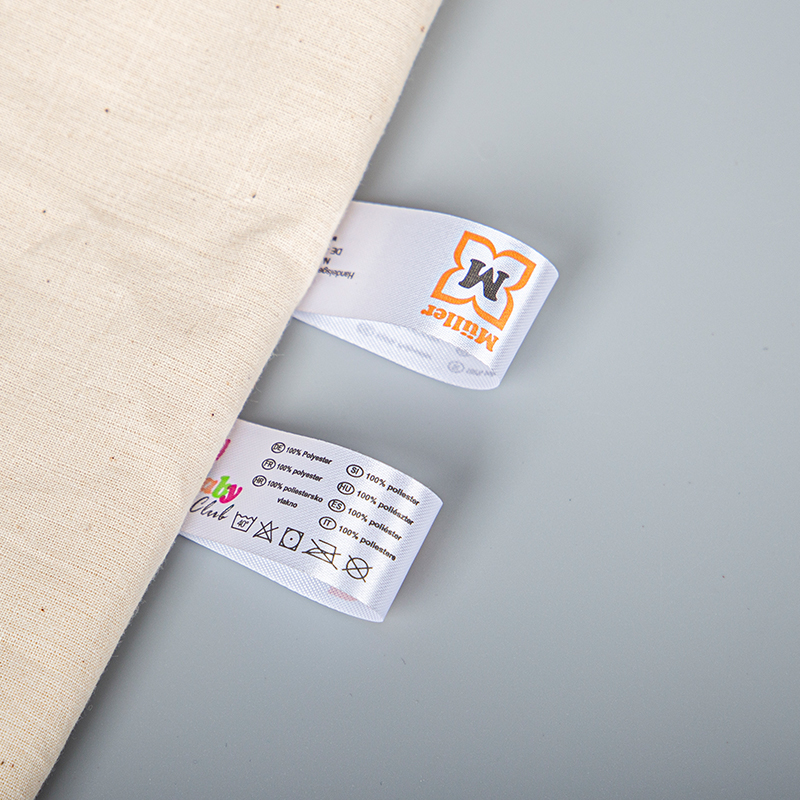
What size should a care label be?
Start with the information rather than a fixed label size. A 25 × 50 mm finished face is one option for a short layout. A 30 × 60 mm or 35 × 70 mm face gives more space for composition details, care wording and symbols. Longer content may work better across two sides or several pages.
We make custom care labels in single-layer, double-layer and multipage formats. The useful question is how to keep your approved information readable while keeping the label comfortable in its intended position. These dimensions are planning examples, not universal standards.
Compare care label dimensions
All figures below are width × height of one finished face before sewing. A center-fold face is measured after folding; a flat label is measured after cutting. The portion inserted into the seam is included in these dimensions and will reduce the exposed height.
| One finished face, mm | Approx. inches | Layout to consider |
|---|---|---|
| 20 × 45 | 0.79 × 1.77 | Narrow layout with brief information |
| 25 × 50 | 0.98 × 1.97 | Short composition and care panel |
| 30 × 60 | 1.18 × 2.36 | Separate areas for wording and symbols |
| 35 × 70 | 1.38 × 2.76 | Longer wording or additional language |
| 40 × 80 | 1.57 × 3.15 | Roomier information panel |
Inches are approximate, calculated using NIST's 25.4 mm per inch. None of these sizes guarantees that a particular word count will fit.
Give each type of information its own space
Composition, care instructions and other garment details do not all need to compete in one tight block. A short heading or a little separation can make the panel easier to follow. Start with the wording and artwork you intend to use, including every language version.
Adding another language does not always mean doubling the label length. Some details may share a row, while other text needs a separate block. We can arrange the supplied content before settling the dimensions. The label's size is a layout decision; it does not establish whether the information is correct for your garment or market.
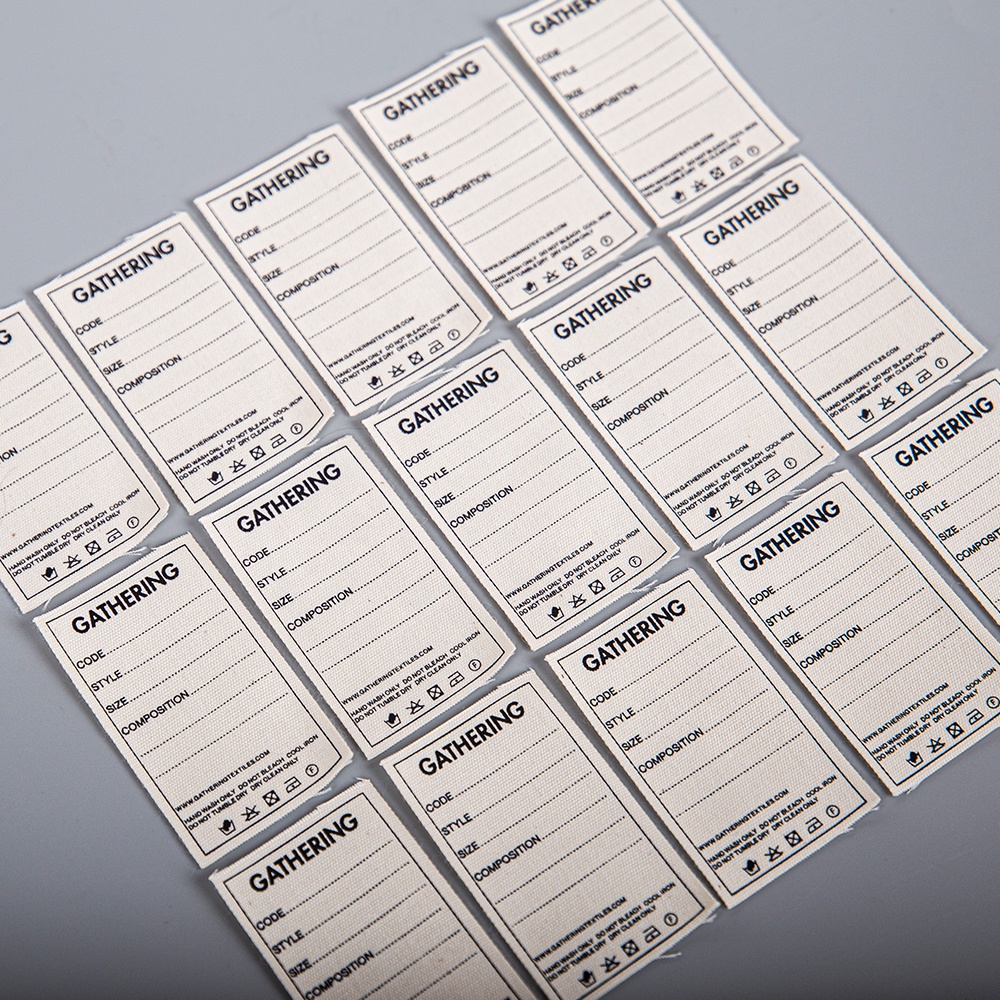
Choose a format before making the label longer
A flat strip keeps short information straightforward. A center fold gives two outward-facing panels, with the raw ends meeting at the attachment edge. The Dutch Label Shop fold guide shows how this fold is used in garment seams.
If a single strip would hang too far down inside the garment, another face or a multipage construction can be more practical. Extra pages also add layers at the seam. We help balance the available space, amount of information and material rather than automatically choosing the longest label.
How a 30 × 60 mm folded face becomes a cut piece
Consider a center-fold care label with a 30 × 60 mm closed face before sewing. With a simple fold halfway along the length and no extra end folds, the unfolded piece is 30 × 120 mm: 60 × 2 = 120 mm.
If both raw ends enter the seam by 6 mm, the exposed face becomes 30 × 54 mm. In this example, leaving 3 mm clear on each side gives 24 mm of text width. Leaving another 6 mm clear near the bottom fold gives a 48 mm-high text area: 60 − 6 − 6 = 48 mm.
These are example allowances. They show why a 30 × 60 mm label does not offer a full 30 × 60 mm area for printed information. A different seam, fold or page construction will need a different layout.
Match the label to where it sits
We offer polyester, nylon, cotton and nonwoven options for suitable care-label designs. The feel and thickness matter when a long label sits against the body. A roomier layout in a lighter material may suit one garment, while a shorter folded format works better in another.
An inside side seam can accommodate a portrait panel. A narrow hem or a small garment may need a shorter face. Keep the orientation consistent with how someone will open and read it. A garment photo helps us see the available area without asking you to choose every finishing detail first.
Keep the layout consistent across garments
A collection can share the same panel structure while the composition and care information changes by style. Leave some flexibility for the longest wording in the range. This helps avoid a different label size for every small text change.
Brand and size details can also sit on separate labels. Keeping the care panel focused on useful garment information often makes it easier to read, while a small size tab remains easy to find.
Frequently Asked Questions
Related Guides & Products
- Custom Care Labels
- Printed Label Size Guide
- Custom Size Labels
- Care Sticker Size Guide: Fit Symbols, Fiber Content & Wording
Send your wording, a garment photo and the quantity. We will help choose the size, material and number of faces.
Plan Your Care Labels