
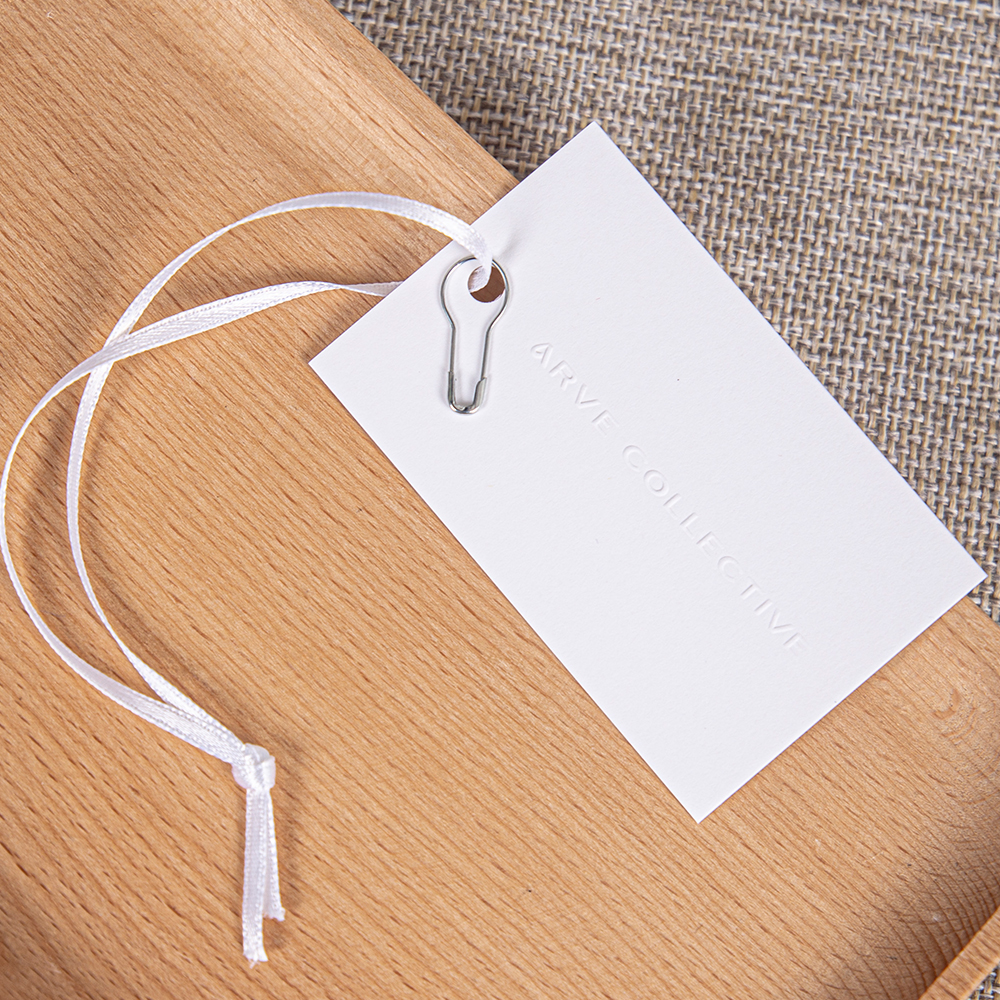
Hang tag size chart in mm and inches
For a simple clothing hang tag, we suggest starting with 50 × 90 mm, about 1.97 × 3.54 inches. It gives a portrait layout room for your logo on the front and short product information on the back.
These are suggested design sizes, not industry standards or a stock list. All sizes below describe the finished flat card, width × height, with the design upright. The string and any printing bleed are separate.
| Size in mm | Approx. size in inches | A useful starting point for |
|---|---|---|
| 30 × 50 | 1.18 × 1.97 | A small logo tag for a hat or accessory |
| 40 × 70 | 1.57 × 2.76 | A compact tag with a logo and a few short lines |
| 50 × 90 | 1.97 × 3.54 | T-shirts, shirts and everyday clothing |
| 60 × 60 | 2.36 × 2.36 | A square logo layout |
| 60 × 100 | 2.36 × 3.94 | A larger logo, more text or a separate code area |
| 70 × 120 | 2.76 × 4.72 | A more prominent tag for outerwear or a short brand story |
The conversions use 1 inch = 25.4 mm, rounded to two decimal places. Use one unit for the production drawing so rounded conversions do not change your chosen size.
Choose a size for the garment and the message
A paper cutout at the attachment point helps you judge the size. Keep it in proportion to the garment: a small accessory and a heavy coat may need different designs.
For hats and small accessories
Start around 30 × 50 or 40 × 70 mm if you only need a logo and a short line of text. A simple layout leaves room around the hole without making the lettering too small.
For T-shirts, shirts and dresses
Try 50 × 90 mm for a vertical design. Put the main brand mark on one side and product details on the other. A 60 × 60 mm square can suit a compact, centered logo.
For jackets or a longer story
Consider 60 × 100 or 70 × 120 mm when the tag carries several details. A folded card is another option when you want more space while keeping a smaller front face.
Flat tags and folded tags use different measurements
Printing both sides of a flat tag does not change its dimensions. For a folded tag, give the open size, closed size and fold direction.
For a simple card that opens like a book, a 50 × 90 mm closed tag starts with a 100 × 90 mm flat card, folded down the middle. Each panel is 50 mm wide. A top-fold version with the same closed size starts at 50 × 180 mm, folded halfway down its height.
Those are equal-panel examples. We adjust the final cutting and fold layout for the paper and construction. For an unusual shape, give the widest width and tallest height; the usable space inside the outline may be smaller.
Leave room for the hole and the string
Keep the hole away from your logo and important text. Its position affects how the tag hangs, especially with a top corner hole or a layered tag set.
Our hang tag strings include cord diameters from 0.8–3 mm. Allow for the end fitting too. We choose the hole size and edge distance to suit your card, fitting and any metal eyelet.
Finished size is different from artwork with bleed
Bleed extends a printed background beyond the cutting line. It is trimmed away, so it does not make the finished tag larger. Adobe explains this distinction and advises using the bleed needed for the particular print job.
For example, if we agree on 3 mm bleed on each edge of a 50 × 90 mm finished tag, the artwork extends across 56 × 96 mm. That is 50 + 3 + 3 by 90 + 3 + 3. The 3 mm allowance is an example, not a fixed requirement for all our tags.
Make space for readable text and a QR code
Lay out your actual wording before settling on a size. A short web address needs less room than a paragraph, and a wide logo may suit a horizontal card. Print the layout at actual size to see whether the smallest text is comfortable to read.
A QR code also needs clear space around it. DENSO WAVE specifies a border four modules wide on every side; modules are the small squares in the code. The final print size depends on the code and printing conditions. Keep it clear of the hole and fold, and try scanning the printed sample.
A simple example: a tag for a T-shirt
For a T-shirt tag with a logo, style name, color and size, try a 50 × 90 mm flat card. Put the logo on the front and the three product details on the back, leaving room for the hole.
If the back feels crowded, moving to 60 × 100 mm adds 10 mm in both directions. If you also want a longer message, the 50 × 90 mm closed folded option keeps the same front size. We can help arrange your artwork across either format.
Frequently Asked Questions
Related Guides & Products
- Custom Hang Tags
- Custom Hang Tag Strings
- Sample Development
- Hang Tag String Size Guide: Cord Diameter, Loops & Length
Send us your logo, the wording you want on the tag and a photo of your garment. We’ll help with the size and layout.
Ask About Your Hang Tags